
The distinction between bipolar II disorder and personality vulnerabilities usually lies in the pattern, duration, and structure of emotional change.
Personality vulnerabilities often involve emotional reactions that are closely linked to stress, relationships, rejection, or perceived interpersonal threat.
Bipolar II disorder, by contrast, involves more distinct mood episodes characterised by measurable shifts in mood, energy, sleep, cognition, motivation, and behaviour.
This distinction matters because the treatment approach, clinical formulation, and long-term management can differ substantially.
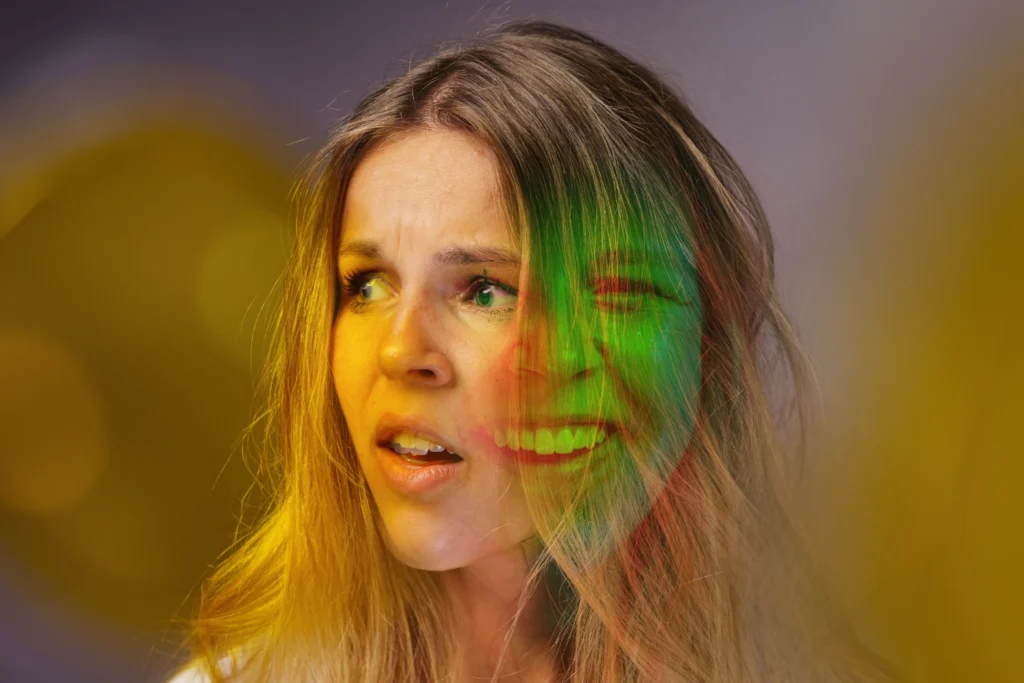
What characterizes bipolar II disorder?
Bipolar II disorder is a mood disorder defined by recurrent depressive episodes alongside episodes of hypomania.
Hypomania may involve:
- increased energy
- accelerated thinking
- reduced need for sleep
- increased confidence
- increased sociability
- impulsive behaviour
- increased goal-directed activity
By definition, hypomania does not involve psychotic symptoms or marked functional impairment. If psychosis is present, the episode meets criteria for mania rather than hypomania.
In bipolar II disorder, depressive episodes are often more impairing and more clinically prominent than the hypomanic episodes themselves.
Are personality vulnerabilities the same as a personality disorder?
Not necessarily.
Personality vulnerabilities refer to longstanding emotional and behavioural tendencies that influence how a person manages stress, relationships, criticism, or uncertainty.
These may include:
- emotional sensitivity
- fear of rejection
- fluctuating self-esteem
- interpersonal intensity
- difficulty regulating emotion under stress
These patterns may cause distress without meeting criteria for a formal personality disorder.
Emotional reactivity alone does not indicate bipolar disorder.
How do clinicians distinguish the two?
One of the most important distinctions is whether the emotional shift is reactive or episodic.
With personality vulnerabilities, emotional changes are often strongly linked to external ‘triggers’ such as:
- conflict
- perceived rejection
- abandonment fears
- interpersonal stress
- criticism
The emotional response is often intense but remains contextually understandable.
In bipolar II disorder, mood episodes may still be influenced by stress, but they often become sustained and disproportionate to immediate circumstances.
A person may experience:
- reduced need for sleep
- increased activity
- racing thoughts
- increased confidence
- impulsivity
- elevated drive
These shifts usually represent a clear departure from baseline functioning.
Why is bipolar II often misunderstood?
One reason bipolar II can be difficult to identify is that hypomania does not always feel problematic.
Some people experience it initially as:
- increased productivity
- increased creativity
- greater sociability
- sharper thinking
- stronger motivation
Clinical attention is therefore often sought during depressive phases rather than elevated states.
At the same time, emotionally unstable personality patterns can outwardly resemble bipolar fluctuations.
This overlap makes careful longitudinal assessment essential.
Can an experience of trauma complicate the diagnosis?
Yes.
Trauma-related affective instability can sometimes resemble aspects of bipolarity, particularly where there is hyperarousal, dissociation, or interpersonal sensitivity.
Trauma can significantly influence emotional regulation, attachment, and stress tolerance.
In assessment, clinicians often examine:
- triggers for emotional shifts
- the duration of mood changes
- interpersonal context
- baseline identity stability
- biological rhythm changes
- family psychiatric history
Sometimes diagnostic clarity only emerges over time.
What role does sleep play?
Sleep is often highly informative.
In bipolar II disorder, reduced need for sleep during hypomania is often disproportionate to baseline functioning. A person may sleep only a few hours and still feel energised.
This differs from insomnia, where exhaustion remains despite difficulty sleeping.
Changes in circadian rhythm are strongly associated with bipolar spectrum conditions and often form part of the assessment.
Why does the distinction matter?
The distinction has direct treatment implications.
Bipolar II disorder may require mood-stabilising treatment alongside psychological therapy.
Personality-based emotional vulnerabilities may respond more strongly to therapies focused on emotional regulation, attachment patterns, interpersonal functioning, and coping strategies.
The aim of assessment is not simply diagnosis, but formulation.
Understanding the pattern and structure of emotional change allows treatment to be more accurate and more effective.
Ready when you are – Orudra Mindspace
At Orudra Mindspace, we provide comprehensive assessment and evidence-based treatment for mood disorders, emotional dysregulation, trauma-related presentations, and complex psychological difficulties.
Telehealth and in-person consultations are available across Australia.
This article is intended for general informational purposes only and does not replace personalised medical or psychiatric advice.
Frequently asked questions
1. What are the common features of bipolar II disorder?
Bipolar II disorder is characterised by episodes of major depression alongside at least one episode of hypomania.
Hypomania may involve increased energy, reduced need for sleep, accelerated thinking, increased confidence, greater activity, or impulsive decision-making.
In many cases, the depressive episodes are more impairing than the hypomanic ones.
2. How is bipolar II disorder different from personality vulnerabilities?
Bipolar II disorder involves distinct mood episodes that represent a noticeable change from a person’s usual baseline.
Personality vulnerabilities are typically more longstanding and trait-based, with emotional shifts that are often reactive to interpersonal stress, rejection, or environmental pressures.
3. Can trauma-related difficulties look similar to bipolar II disorder?
Yes.
Trauma can affect emotional regulation, stress reactivity, and interpersonal functioning in ways that may resemble aspects of bipolarity.
However, this does not necessarily mean bipolar II disorder is present.
Careful assessment is often needed to distinguish trauma-related emotional instability from an episodic mood disorder.
4. Should I see a psychiatrist or psychologist to clarify whether I may have bipolar II disorder or personality vulnerabilities?
Both can be helpful, but if the main question is whether mood changes may represent bipolar II disorder, a psychiatrist is often the better starting point.
This is because differentiating episodic mood disorder from longstanding personality-based emotional patterns often requires careful assessment of mood chronology, sleep changes, energy shifts, family history, and overall functioning over time.
A psychologist can also play an important role, particularly in exploring trauma, attachment patterns, emotional regulation, and interpersonal functioning.
In many cases, both perspectives can be valuable.